What Is Sovereign AI and Why It Matters for Enterprises
A practical explanation of sovereign AI, private AI systems, data control, model choice, and enterprise governance.
What Is Sovereign AI and Why It Matters for Enterprises
A practical explanation of sovereign AI, private AI systems, data control, model choice, and enterprise governance.
What Is Sovereign AI and Why It Matters for Enterprises
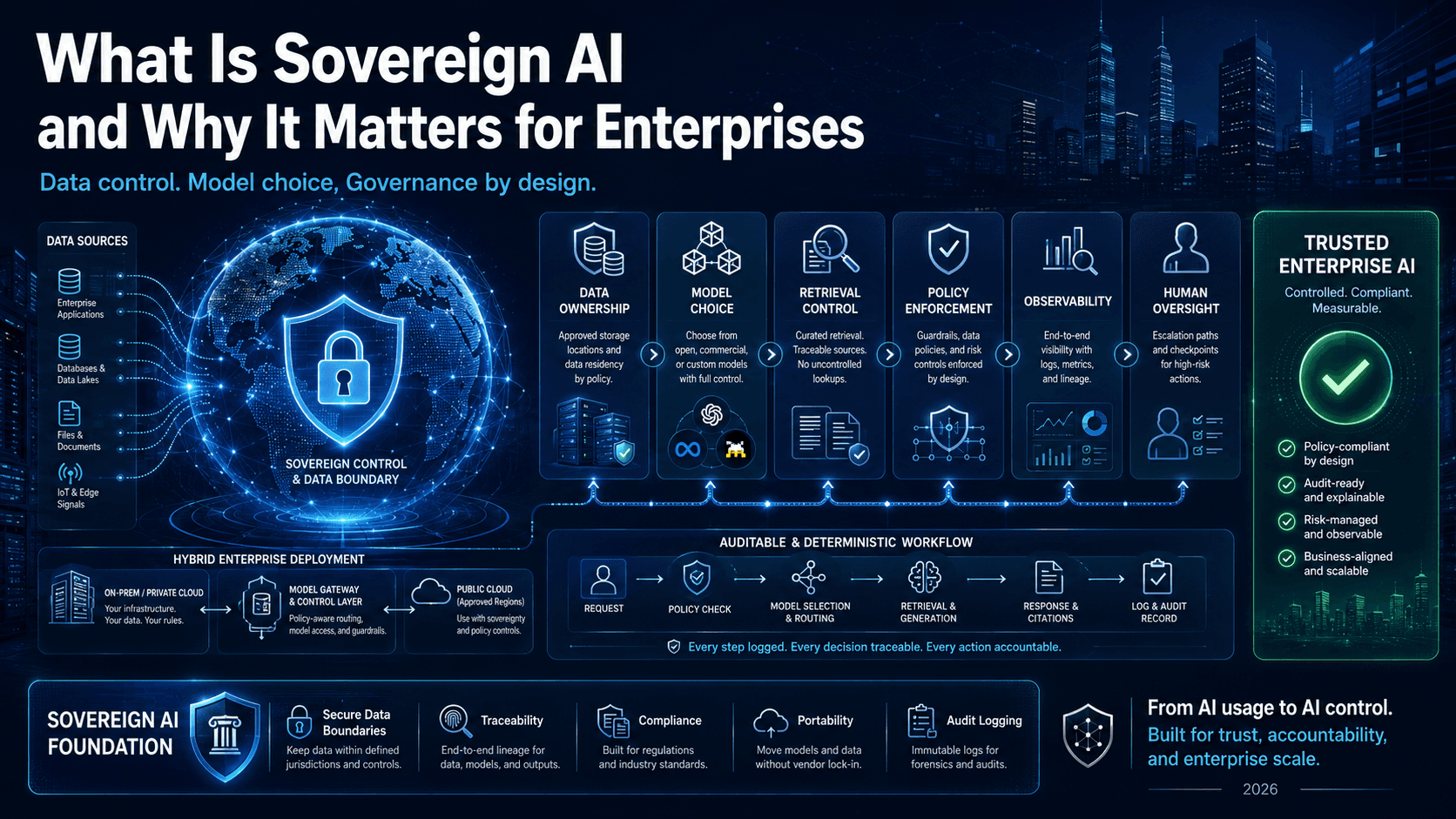
Sovereign AI is the ability to design, run, and govern AI systems under deliberate control of data, access, models, deployment, and policy. It does not require every model to run offline. It requires that every architecture decision — where data flows, which models are used, who can access the system, how decisions are logged — be made on purpose, with accountability attached. For enterprises in 2026, this is no longer an abstract concept. AI is no longer a theoretical experiment. It already drives critical operational decisions, from fraud detection and patient journey management to energy infrastructure operations. In this context, sovereignty is no longer abstract — it becomes a practical requirement for deploying AI with confidence.
The Stakes Have Changed
Today, 83% of companies view sovereign AI as at least moderately important to their strategic planning, according to Deloitte's 2026 State of AI in the Enterprise. Nearly half consider it extremely important, and 66% are at least moderately concerned about reliance on foreign-owned AI technologies and infrastructure. The pressure comes from two directions at once. Regulation is tightening: Article 50 transparency obligations apply from August 2026, while the 2026 AI Omnibus moved the adopted high-risk application dates to December 2027 for Annex III systems and August 2028 for the regulated-product path. Penalty tiers depend on the type of noncompliance; the highest €35 million or 7% tier concerns prohibited practices. And 71% of executives, investors, and government officials surveyed by McKinsey characterize sovereign AI as an existential concern or strategic imperative to their organizational goals. Meanwhile, while 95% of enterprise leaders plan to build their own AI and data platform within the next thousand days, only 13% are currently on track. The gap between intention and readiness is where most enterprises are sitting today.
What Sovereign AI Actually Covers
AI sovereignty has two primary dimensions. One concerns how AI is developed and used — including system ownership, safeguards to protect citizens and uphold domestic rules, and aligning AI with national regulations. The other focuses on geography and jurisdiction — data residency and where compute physically occurs. For enterprise builders, both dimensions translate into architectural decisions:
- Data ownership: business data should stay inside approved storage and processing boundaries, with documented lineage and access controls.
- Model choice: teams should be able to route queries to cloud models, local models, or open-weight models based on sensitivity, cost, and regulatory classification.
- Retrieval control: RAG systems should retrieve from approved indexes with metadata, access filters, and citations traceable back to the source.
- Policy enforcement: prompts and responses should pass through guardrails before being trusted, logged, or acted upon.
- Observability: token usage, latency, cost, retrieved sources, confidence scores, and evaluation results should be visible and auditable.
- Agentic oversight: as AI systems move from answering questions to taking actions, human oversight checkpoints are not optional — they are a regulatory requirement.
Sovereign AI Is an Architecture Decision, Not a Product
Sovereign AI is turning governance questions into concrete design and infrastructure decisions. Regulations are pushing enterprises away from reliance on large, generic models alone and toward platforms that safely integrate a mix of specialized, enterprise-grade AI tools — deliberately distributing workloads across multiple models to reduce exposure while maintaining consistency and control at scale. A practical enterprise design includes a frontend, an API layer, a model gateway, a retrieval backend, a vector store, monitoring, evaluation, and audit logging. The key is making each layer inspectable. Teams should be able to answer: what happened when a user asked a question, how evidence was selected, where the model call was routed, and what controls were triggered when confidence was low. A sovereign AI system is defined not by tools, but by principles: determinism, traceability, and portability. Agentic systems unlock powerful capabilities, but unconstrained autonomy introduces risk under regulations like the EU AI Act. Using deterministic orchestration frameworks, organizations can wrap workflows in containerized APIs that run consistently across cloud and on-premise environments without sacrificing transparency.
The Agentic Layer Raises the Stakes
Most enterprises are now moving beyond RAG chatbots into agents — systems that plan, invoke external tools, and execute multi-step actions with reduced human involvement. These systems are being deployed at scale across customer service, recruitment, clinical decision support, and critical infrastructure management. The EU AI Act regulates them through a risk-based framework, but enterprises face simultaneous obligations under GDPR, the Cyber Resilience Act, the Data Governance Act, and NIS2. High-risk agentic systems with untraceable behavioural drift will struggle to satisfy the AI Act's evidence requirements. Article 12 requires high-risk systems to technically allow automatic event recording, Article 14 requires effective human oversight, and Article 19 sets provider log-retention duties. The 2026 AI Omnibus moved the adopted high-risk application dates, but teams still need to design these controls early because missing historical logs and release evidence cannot be backfilled reliably.
Why Most Enterprises Are Still Behind
Enterprise interest in sovereign AI capabilities is now widespread, but while most have it as part of their roadmaps for 2026, few have a detailed strategy, action plan, budgets, and workload tiering. Sovereign cloud and AI migrations typically take three to four years — not primarily due to technology limitations, but because of the organizational work required to move regulated workloads. The blockers are rarely technical. They are process, ownership, and documentation gaps: unclear data lineage, inconsistent access controls, no model registry, no evaluation framework, and no escalation path when an AI system produces a wrong or harmful output.
A Practical Starting Point
Start with a private RAG system over a controlled document set. Add citations, access filters, logging, and answer validation before you add anything else. Then expand into agents, workflow automation, and multi-model routing only after the governance foundation is solid. 2026 is the year the industry turns its attention to results. The enterprises that prove they can handle data securely, manage AI resources with effective utilization, and protect users with sovereignty will lead the next phase of AI adoption. Sovereign AI begins when teams stop treating AI as a prompt box and start treating it as production infrastructure — with the same accountability, auditability, and operational discipline they would apply to any system that touches sensitive data or drives real decisions.