Hallucination Control in Enterprise RAG: A Production Engineering Guide
A senior engineer's framework for classifying, detecting, and systematically eliminating hallucination across the full RAG pipeline — from retrieval quality to atomic fact verification, NLI-based validation, and continuous production monitoring.
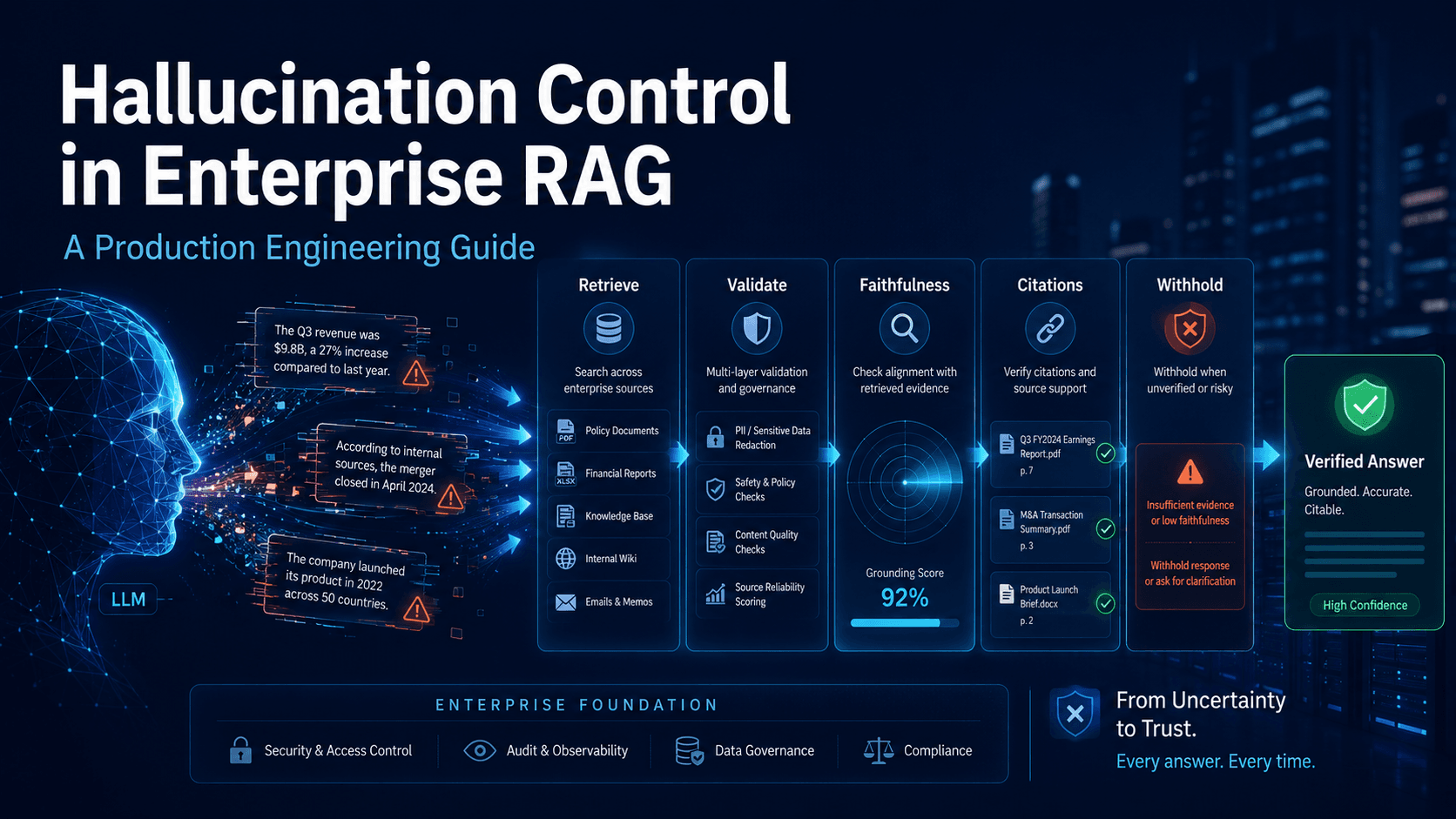
Hallucination Control in Enterprise RAG: A Production Engineering Guide
Hallucination is not a model problem that better prompting will solve. It is a systems failure that manifests at multiple points across the retrieval and generation pipeline — and in enterprise deployments, it carries consequences that go well beyond a wrong answer.
A hallucinated clause in a contract summary. A fabricated drug interaction in a clinical knowledge base. A policy interpretation that cites a superseded document as current guidance. These are not edge cases. Studies show approximately 1.75% of user reviews in production LLM applications report hallucination-related issues — a rate that sounds small until it is applied to ten thousand daily queries from employees making real decisions.
The goal of hallucination control in enterprise systems is not to reduce the frequency of hallucinations in a benchmark. It is to make every production answer either traceable to verified evidence or transparently withheld when that evidence is absent.
This guide addresses that goal at the engineering level: taxonomy first, then detection layer by layer, then monitoring, then the governance implications most teams discover only after an incident.
The Taxonomy You Need Before You Build Detectors
Most teams treat hallucination as a single problem. It is not. It has at least four structurally different failure modes, each of which requires a different detection approach:
Faithfulness Hallucination
The model generates a claim that is not supported by — or directly contradicts — the retrieved context it was given. This is the primary failure mode in RAG systems and the one most detection frameworks target. Faithfulness hallucination does not require the claim to be factually wrong about the world; it only requires that the answer goes beyond or diverges from the retrieved evidence.
Example: Retrieved chunk states parental leave is 16 weeks. Model answers "18 weeks, which may be extended further." The extension is a fabrication that sounds plausible but has no grounding in the source.
Factuality Hallucination
The model states something that contradicts established, externally verifiable facts — independent of what was retrieved. This occurs when the model's parametric knowledge (encoded during training) overrides or supplements the retrieved context.
Example: A regulatory document is retrieved. The model correctly quotes it, then adds a "by the way" elaboration about enforcement history that is factually incorrect, sourced entirely from training data.
Attribution and Citation Hallucination
Correct factual content is attributed to the wrong source, or a citation is generated that appears legitimate — with realistic document names, section numbers, and dates — but does not exist or does not support the stated claim. Stanford's 2025 legal RAG reliability research found that even well-curated retrieval pipelines can fabricate citations. This failure mode is particularly dangerous because it presents confident, professional-looking false authority.
Example: The answer correctly describes GDPR Article 17 but cites it as Article 21. Or generates "per ISO 27001:2022 Section 8.4.3" when no such section says what is claimed.
Completeness Hallucination (Omission)
The model produces a technically accurate but materially misleading answer by omitting information present in the retrieved context that would change the interpretation. The model does not fabricate; it selects. In regulated environments, selective omission can be as consequential as outright fabrication.
Example: A retrieved policy states an action is permitted "subject to manager approval and documentation." The model answers that the action is permitted, omitting the conditions entirely.
Understanding which failure mode is occurring determines which detector to deploy and where in the pipeline to deploy it.
Detection Architecture: Layered, Not Single-Point
A single post-generation hallucination check is not sufficient for enterprise RAG. By the time a check runs at the output layer, incorrect retrieval has already contaminated the model context. The correct architecture deploys detection at three distinct stages.
QUERY
  │
  ▼
┌─────────────────────────────────────────┐
│  RETRIEVAL QUALITY GATE                 │  ← Stage 1: Pre-generation
│  Relevance thresholds                   │
│  Source freshness / expiry checks       │
│  Conflicting document detection         │
│  Confidence signal: RETRIEVE or REFUSE  │
└────────────────────┬────────────────────┘
                     │
                     ▼
┌─────────────────────────────────────────┐
│  GENERATION WITH GROUNDING CONSTRAINTS  │
│  Evidence-only prompt instructions      │
│  Citation injection at generation time  │
│  Self-reflection pass on low confidence │
└────────────────────┬────────────────────┘
                     │
                     ▼
┌─────────────────────────────────────────┐
│  POST-GENERATION VALIDATION             │  ← Stage 2: Post-generation
│  NLI faithfulness scoring               │
│  Atomic fact decomposition + grounding  │
│  Citation existence verification        │
│  LLM-as-judge for complex cases         │
│  Decision: SERVE / FLAG / WITHHOLD      │
└────────────────────┬────────────────────┘
                     │
                     ▼
┌─────────────────────────────────────────┐
│  PRODUCTION MONITORING                  │  ← Stage 3: Continuous
│  RAGAS metric tracking over time        │
│  Drift detection on faithfulness scores │
│  Anomaly alerting on score degradation  │
│  Feedback integration into evaluation   │
└─────────────────────────────────────────┘
Stage 1: Retrieval Quality as Hallucination Prevention
The most effective way to prevent hallucination is to prevent bad retrieval from reaching the model. Every claim a model hallucinates that was not in the retrieved context represents a retrieval failure, not a generation failure. Detection after the fact is always more expensive than prevention at the source.
Minimum Relevance Thresholds
Do not pass low-relevance chunks into model context regardless of top-K configuration. After reranking, enforce a minimum relevance score — typically 0.6–0.7 for a cross-encoder — below which a chunk is excluded. A retrieval pass that returns only low-scoring chunks should trigger an explicit confidence-low state rather than proceeding to generation.
Conflicting Document Detection
When retrieved chunks from different documents make contradictory claims, naive generation will synthesize a response that blends both — often producing a smoothly worded answer with no internal consistency. Before passing to the model, check whether top-ranked chunks carry semantic contradiction on key claims using a lightweight NLI check. Flag contradictions explicitly in the prompt context rather than letting the model resolve them silently.
def detect_retrieval_conflicts(chunks: list[Chunk], threshold: float = 0.8) -> list[ConflictPair]:
    """
    Identify chunks that contradict each other using an NLI model.
    Returns pairs where one chunk contradicts another with high confidence.
    """
    conflicts = []
    nli_model = load_nli_model()  # e.g. cross-encoder/nli-deberta-v3-base

    for i, chunk_a in enumerate(chunks):
        for chunk_b in chunks[i+1:]:
            result = nli_model.predict([(chunk_a.text, chunk_b.text)])
            contradiction_score = result[0]["contradiction"]
            if contradiction_score > threshold:
                conflicts.append(ConflictPair(
                    chunk_a=chunk_a,
                    chunk_b=chunk_b,
                    contradiction_score=contradiction_score
                ))
    return conflicts
When conflicts are detected, the model prompt should make them visible rather than invisible:
Note: The retrieved documents contain conflicting information on this topic.
Document A (HR Policy v3.1, 2024) states: [...]
Document B (HR Policy v2.8, 2022) states: [...]
Acknowledge this conflict in your response and do not synthesize a single answer that obscures it.
Document Freshness Enforcement
Answers grounded in expired or superseded documents are a common source of enterprise hallucination that does not originate in the model at all — it originates in stale index content being returned as authoritative. Every chunk should carry an expiry_date in metadata, and retrieval should hard-filter documents past their effective dates unless the query explicitly requests historical context.
Stage 2: Post-Generation Validation
NLI-Based Faithfulness Scoring
Natural Language Inference (NLI) models evaluate whether a hypothesis (a claim in the generated answer) is entailed by, contradicts, or is neutral with respect to a premise (a retrieved source chunk). This is the most reliable automated approach for faithfulness hallucination detection.
The standard production implementation uses DeBERTa-v3 fine-tuned on NLI + fact-checking datasets (MNLI, FEVER, ANLI). It is fast enough for synchronous validation on most enterprise query volumes.
from transformers import pipeline

class FaithfulnessValidator:
    def __init__(self):
        self.nli = pipeline(
            "text-classification",
            model="cross-encoder/nli-deberta-v3-base"
        )

    def score_answer_faithfulness(
        self,
        answer: str,
        source_chunks: list[str]
    ) -> FaithfulnessResult:

        # Decompose answer into sentences (atomic claims)
        answer_sentences = split_into_sentences(answer)

        results = []
        for sentence in answer_sentences:
            best_entailment = 0.0
            best_source = None

            for chunk in source_chunks:
                # NLI: is this sentence ENTAILED by the chunk?
                score = self.nli(
                    f"{chunk} [SEP] {sentence}",
                    truncation=True
                )
                entailment_score = next(
                    s["score"] for s in score if s["label"] == "ENTAILMENT"
                )
                if entailment_score > best_entailment:
                    best_entailment = entailment_score
                    best_source = chunk

            results.append(SentenceResult(
                sentence=sentence,
                entailment_score=best_entailment,
                grounding_source=best_source,
                verdict="supported" if best_entailment > 0.70 else "unsupported"
            ))

        supported_count = sum(1 for r in results if r.verdict == "supported")
        faithfulness_score = supported_count / len(results) if results else 0.0

        return FaithfulnessResult(
            overall_score=faithfulness_score,
            sentence_results=results,
            verdict=self._classify(faithfulness_score)
        )

    def _classify(self, score: float) -> str:
        if score >= 0.85:   return "supported"
        if score >= 0.65:   return "partially_supported"
        if score >= 0.40:   return "weakly_supported"
        return "unsupported"
The sentence-level decomposition is important. A long answer can score well on average faithfulness while containing a single sentence that is entirely fabricated. NLI at the sentence level exposes these failures; NLI at the full-answer level masks them.
Atomic Fact Decomposition with FACTScore
For long-form answers — summaries, comparative analyses, multi-clause policy interpretations — NLI at the sentence level is still too coarse. FACTScore decomposes the generated answer into atomic propositions (individual verifiable claims) and independently checks each against the source corpus. The FACTScore is the fraction of atomic facts that are supported by retrieved evidence.
Answer: "The parental leave policy provides 16 weeks of fully paid leave for primary
         caregivers. Partners are entitled to 4 weeks. The policy was updated in January
         2024 to include adoption and surrogacy pathways."

Atomic fact decomposition:
  [1] Parental leave is 16 weeks              → supported (retrieved chunk, section 4.2)
  [2] Leave is fully paid                     → supported (retrieved chunk, section 4.3)
  [3] Primary caregivers receive this benefit → supported
  [4] Partners receive 4 weeks               → UNSUPPORTED (retrieved chunk says "2 weeks")
  [5] Policy updated January 2024            → supported (document metadata)
  [6] Update includes adoption pathways      → supported
  [7] Update includes surrogacy pathways     → UNSUPPORTED (not mentioned in any chunk)

FACTScore: 5/7 = 0.71
This is a significantly more precise signal than an overall "the answer seems mostly grounded" judgment. In the example above, claims [4] and [7] would reach users as confident statements with no attribution to the fabrication. FACTScore surfaces them at the claim level, making them actionable.
Citation Existence Verification
A dedicated citation verification step should confirm that every cited document reference in the generated answer: (a) corresponds to a document that was actually retrieved in this query's context, and (b) the cited section of that document actually supports the adjacent claim. This catches attribution hallucinations before they reach users.
def verify_citations(answer: str, retrieved_chunks: list[Chunk]) -> CitationReport:
    citations = extract_citations_from_answer(answer)  # regex or LLM extraction
    retrieved_doc_ids = {chunk.document_id for chunk in retrieved_chunks}

    report = CitationReport()
    for citation in citations:
        if citation.document_id not in retrieved_doc_ids:
            report.add_fabricated_citation(citation)
        else:
            supporting_chunk = find_chunk_supporting_claim(
                citation=citation,
                chunks=retrieved_chunks
            )
            if supporting_chunk is None:
                report.add_misattributed_citation(citation)
            else:
                report.add_verified_citation(citation, supporting_chunk)

    return report
Any fabricated citation — one referencing a document not in the retrieved set — is an immediate WITHHOLD decision. Any misattributed citation is flagged for human review.
LLM-as-Judge for Complex Faithfulness Assessment
NLI models excel at sentence-level entailment but struggle with complex multi-hop reasoning, implicit contradictions, and completeness hallucination. For these cases, an LLM-as-judge pass provides higher-fidelity assessment at the cost of additional latency and token spend.
The judge prompt should be structured around specific, binary questions rather than an open-ended quality score:
You are a faithfulness auditor. Evaluate the ANSWER against the SOURCE DOCUMENTS provided.

For each question below, respond with PASS, FAIL, or UNCERTAIN, and one sentence of justification.

1. Does the answer contain any factual claim not found in the source documents?
2. Does the answer contradict any statement in the source documents?
3. Are all citations in the answer traceable to the source documents provided?
4. Does the answer omit any material qualification or condition present in the source documents that would change the meaning of the answer?
5. Does the answer state any quantity, date, or identifier differently from the source documents?

SOURCE DOCUMENTS:
{retrieved_context}

ANSWER TO EVALUATE:
{generated_answer}
Gartner research indicates that over 40% of agentic AI projects are projected to be canceled by end of 2027 due to reliability concerns — a figure that makes the investment in rigorous evaluation frameworks clearly justified.
Decision Routing: What to Do with Validation Results
Validation is only useful if it changes system behavior. Define explicit routing rules based on validation output:
| Validation Result | Action |
|---|---|
| Faithfulness ≥ 0.85, no fabricated citations, FACTScore ≥ 0.80 | Serve answer with citations |
| Faithfulness 0.65–0.85, partial support | Serve with explicit uncertainty disclosure |
| Faithfulness 0.40–0.65, weakly supported | Withhold answer; surface closest sources with "This question could not be fully answered from available documents" |
| Faithfulness < 0.40 OR any fabricated citation | Withhold; log for knowledge gap review; optionally trigger document request workflow |
| Conflicting evidence detected | Serve conflict disclosure; do not synthesize a single answer |
| Citation verification failure | Withhold immediately; flag as potential systematic issue |
The key design principle: withholding is a valid system output. A governance system that says "I don't have enough information" is doing its job correctly. A system that always produces an answer, regardless of evidence quality, is not governed — it is only prompted.
Stage 3: Production Monitoring and Drift Detection
Core Metrics to Track Continuously
| Metric | Definition | Alert Threshold |
|---|---|---|
| Faithfulness score | Fraction of answer sentences supported by retrieved context | Drop > 0.05 over 7-day rolling window |
| FACTScore | Fraction of atomic facts grounded in retrieved evidence | Drop > 0.05 over 7-day rolling window |
| Withhold rate | Fraction of queries that failed validation and were withheld | Spike > 2× baseline (signals corpus gap or retrieval degradation) |
| Fabricated citation rate | Fraction of answers containing at least one fabricated citation | Any value > 0 in production triggers incident review |
| Retrieval null rate | Fraction of queries where no chunk exceeded relevance threshold | Rising trend signals index staleness |
| User correction rate | Fraction of served answers that received explicit negative feedback | Rising trend signals user-visible quality degradation |
Evaluation Cadence
Synchronous (every query): NLI faithfulness scoring and citation verification. These run in the serving path and gate every response.
Asynchronous (sampled, near-real-time): FACTScore on 10–20% of responses, LLM-as-judge on flagged responses. Results feed into the monitoring dashboard within minutes.
Batch (daily): Full RAGAS evaluation against the golden dataset. Regression in any metric generates an automated deployment block until the regression is diagnosed and resolved.
Periodic (weekly): Human red-team review of withheld responses and low-confidence answers. This uncovers systematic gaps in the document corpus that automated metrics miss.
Connecting Monitoring to Corpus Management
Retrieval null rate and withhold rate spikes are the most actionable monitoring signals for knowledge management teams, not just engineering teams. A sustained rise in retrieval nulls on a particular topic cluster means the corpus has a gap — a document category that users need but that has not been indexed. This signal should feed directly into the document ingestion backlog.
Governance Implications: What Regulators Actually Require
Hallucination control is moving from an engineering aspiration to a legal obligation in regulated environments.
The EU AI Act classifies AI systems used in employment decisions, credit assessment, healthcare triage, and access to essential services as high-risk. For these systems, Article 9 requires documented risk management systems that address the risk of outputs causing harm — which includes factually incorrect outputs. Article 12 requires logging of events in a form sufficient for post-incident investigation, meaning validation decisions (served, withheld, flagged) must be in the audit trail alongside the query and answer.
Practically, this translates to four non-negotiable requirements:
1. Immutable validation logs. Every validation decision — not just final answers — must be logged with the query ID, retrieved chunk IDs, validation scores, and routing decision. If an answer is later found to be incorrect and caused harm, the audit log must reconstruct whether the validation pipeline was working and what it produced.
2. Explainable withhold decisions. When the system withholds an answer, the user must receive a substantive response — not an opaque "I can't help with that." The response should indicate why (insufficient evidence, conflicting documents, low confidence) and suggest an alternative path (who to contact, what document to consult).
3. Human escalation capability. High-risk agentic systems must support human override at any decision point. The validation pipeline should include an escalation path where flagged responses route to a human reviewer rather than being silently withheld.
4. Periodic red-team testing. Documented evidence of adversarial testing — deliberately crafting queries designed to elicit hallucinated responses — is increasingly expected in AI governance frameworks. This should include queries with no relevant documents in the corpus (to test withhold behavior), queries with conflicting documents (to test conflict disclosure), and queries designed to elicit parametric knowledge bypass (to test factuality hallucination controls).
Common Failure Patterns to Anticipate
The confident extrapolation. The model retrieves a policy that says X applies under conditions A and B. The user asks about condition C. Rather than withholding, the model extrapolates from A and B and answers about C with apparent certainty. This is caught by strict NLI faithfulness scoring — the extrapolated claim is not entailed by the source — but only if the validation threshold is set conservatively.
The synthesis artifact. Two documents are retrieved that each say something partially relevant. The model combines them into a synthesized answer that is not exactly stated by either. Individually, each sentence may score reasonably on NLI against one source or the other. FACTScore at the atomic claim level is the most reliable detector for this pattern.
The version ambiguity failure. Multiple versions of the same document exist in the index (policy v2.8 and v3.1). The model retrieves chunks from both without distinguishing between them and produces an answer that blends provisions from different document versions. Metadata-driven retrieval filters (filtering by effective date and document version) prevent this at the retrieval layer rather than requiring detection after the fact.
The authority fabrication. The model generates an answer that is factually correct — it knows the answer from training data — but attributes it to a specific document, clause number, or section that does not contain that information. NLI scores high because the claim itself is grounded elsewhere; citation verification catches it because the cited source does not support it.
The Standard to Build Toward
A mature enterprise hallucination control system produces three guarantees:
Every served answer is traceable. Each factual claim can be linked to the specific source chunk that supports it. The link is verifiable by any reviewer, not implied by proximity in the response.
Every withhold decision is auditable. When the system declines to answer, the reason is logged with sufficient detail to diagnose whether the withhold was appropriate or represents a corpus gap to address.
Quality is measurable over time. Faithfulness scores, FACTScore, and citation accuracy are tracked as production metrics with the same operational attention given to latency and availability. A regression in answer quality is treated as an incident, not noticed incidentally in user feedback.
This standard is not aspirational for regulated enterprise AI in 2026. It is the minimum bar for deployment in any environment where the answers will influence real decisions.
Implementing layered hallucination detection for your enterprise RAG system? We design and validate production-grade evaluation pipelines that meet both quality and regulatory requirements.